Why Hire An ASL Interpreter?
Resources and education for healthcare and social service providers
You may be here because you just met your first Deaf person. You came to the right place!
Frequently Asked Questions
-
No. As stated in the Americans with Disabilities act of 1990, Deaf people are never to be held financially responsible for interpreting services, especially in medical settings.
Interpreting and other accessibility services should be considered a normal cost of doing business for healthcare providers, not a surprise expense.
-
No. Friends and family may know ASL well enough to communicate with the Deaf patient, however only a qualified ASL interpreter well versed in medical settings will have the knowledge of medical terminology in both English and ASL. Also, certified ASL interpreters are bound by RID’s Code of professional conduct, their hiring agency, and applicable laws. Friends and family are not held accountable to anyone if something was to go awry at the fault of an unqualified interpreter. This places the liability on the provider.
-
Not recommended. Agencies that specialize in spoken language translation often are not aware of the drastically different industry standards of ASL interpreters. ASL interpreters are a completely different category of access than spoken language translation because ASL interpreters are a disability accommodation under the ADA.
-
While some Deaf people may accept this in limited scenarios, if a Deaf person requests an interpreter it means they prefer to communicate in ASL instead of English. Keep in mind that Deaf people will never request services that are not needed, as it does not benefit them.
-
Yes! Not only are interpreting services a tax write off for your business, but most businesses are eligible for the IRS Disabled Access Credit. This credit is a non-refundable tax credit for 50% of the cost of interpreting over $250 and under $10,000 per year. Thats a tax credit of $5,000! Simply fill out IRS Form 8826. Heres a direct link! https://www.irs.gov/pub/irs-pdf/f8826.pdf
Joint Commission Recommendations
The Joint Commission is responsible for accrediting over 22,000 health care organizations and medical services around the world.
This document titled “Advancing Effective Communication, Cultural Competence, and Patient- and Family-Centered Care” by the Joint Commission is a great resource for healthcare providers navigating communication access. In this document, interpreters are mentioned 219 times, showcasing their importance of equal access to medical care.
Proactivity
It is crucial for healthcare providers to proactively foster relationships with ASL interpreters in their community should a Deaf patient require one. It is not wise to wait until there is a Deaf patient in the waiting room with an immediate concern before frantically Googling “ASL interpreter near me” and hoping one will practically appear.New York State has a groundbreaking law, New York State Code of Rules and Regulations Section 405.7. This requires all hospitals in New York State to develop a language access plan, appoint a Language Access Coordinator, provide interpreters within 10 minutes in the emergency room and 20 minutes elsewhere in the hospital, and notify patients about their rights to language services, among other things. The regulations also prohibit the use of family members, strangers and minor children as interpreters except in emergencies.Even if your state does not legally require a language access plan, it is in everyone’s best interest to implement one. We can help you with this!-
![]()
Americans with Disabilities Act of 1990
-
![]()
Rehabilitation Act of 1973, Section 504
Rehabilitation Act Section 504 applies to all federally funded entities, including any provider who accepts Medicare.
-
![]()
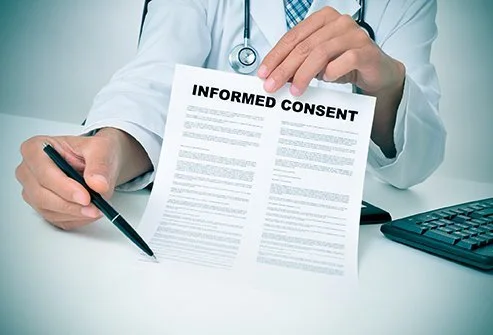
Informed Consent Law
Informed consent to medical treatment is fundamental in both ethics and law. Deaf patients cannot make informed consent without linguistic access to treatment information. This can be a huge liability for healthcare providers, but is easily preventable.
-
![]()
Affordable Care Act Section 1557
Section 1557 of the Affordable Care Act requires covered entities to provide sign language interpreters where needed, and proactively inform patients of their availability.
-
![]()
New York State Code of Rules and Regulations Section 405.7
Requires all hospitals in New York State to develop a language access plan, appoint a Language Access Coordinator, provide interpreters within 10 minutes in the emergency room and 20 minutes elsewhere in the hospital, and notify patients about their rights to language services, among other things. The regulations also prohibit the use of family members, strangers and minor children as interpreters except in emergencies.